









Honorary Doctorate vs Earned Ph.D. : Recognition vs. Qualification
In an era where titles often carry weight beyond their literal meaning, understanding the distinction between an Honorary Doctorate vs Earned Ph.D. becomes more than just an academic exercise—it becomes a matter of truth, ethics, and clarity. While both bear the prestigious prefix “Dr.,” they originate from vastly different paths, each representing a unique form of acknowledgment. However, conflating the two can lead to confusion, misrepresentation, or even legal trouble.
Understanding the Foundation: What Each Title Truly Means
Let’s begin with the basics.
A Ph.D. (Doctor of Philosophy) is an earned academic degree awarded after a candidate has completed rigorous coursework, conducted original research, and successfully defended a dissertation. It typically takes several years to achieve and represents the highest scholarly qualification within a field.
On the other hand, an honorary doctorate, also known as Doctor honoris causa, is a symbolic title bestowed by a university to recognize an individual’s exceptional contributions to society, humanity, or a specific discipline—without requiring them to undertake any academic work.
This core difference—effort versus honor—sets the stage for all other distinctions.
The Journey: Years of Sacrifice vs. A Moment of Recognition
There is no shortcut to a real Ph.D.
It demands years of commitment, including extensive reading, data gathering, academic writing, thesis revisions, and public defense. The path is marked by failure, peer critique, and eventual mastery. This intellectual grind shapes not just knowledge, but character.
An honorary degree, by contrast, is awarded in a single ceremonial moment, often at a university convocation or public ceremony. It acknowledges a person’s societal impact, not academic achievement.
To be clear: both have value. But they do not stand on the same foundation of scholarly rigor.
Why Universities Award Honorary Doctorates
This leads to an important question: Why would prestigious academic institutions award a doctorate to someone who hasn’t studied there?
It turns out, there are multiple valid reasons, and most are deeply strategic:
1. To Recognize Extraordinary Contributions
Honorary degrees are primarily meant to celebrate individuals who have made transformative contributions to society—whether in science, the arts, politics, humanitarian work, or business. These are people whose impact mirrors the university’s mission.
Universities honor not only scholars, but also visionaries and changemakers.
2. To Build Strategic Relationships
Awarding an honorary doctorate can also be a diplomatic gesture. Universities may recognize philanthropists, entrepreneurs, or world leaders—not only for their merit, but also to foster goodwill, funding opportunities, or collaborative initiatives.
This isn’t cynical—it’s symbiotic.
3. To Inspire the Student Body
During commencement ceremonies, honorary recipients are often invited to speak. Their life stories offer real-world examples of perseverance, innovation, or service, thus becoming living role models for graduates stepping into the world.
4. To Reinforce the Institution’s Values
Universities are guided by values: social justice, sustainability, innovation, human development. By choosing honorees who embody these values, the institution cements its cultural identity and public message.
5. To Gain Prestige and Visibility
Media coverage surrounding high-profile honorary doctorates boosts the university’s profile. It generates interest, attracts future students, and often leads to greater community engagement.
In short: Honorary doctorates serve both symbolic and strategic purposes, when conferred responsibly.
Honorary Doctorate vs Earned Ph.D.
Can Honorary Doctorate Recipients Call Themselves “Dr.”?
Here’s where things get ethically and legally complex.
Legally, it depends on the country. Ethically, it depends on clarity and context.
Earned Ph.D. Holders
- Fully entitled to use the prefix “Dr.”
- Earned through academic work and intellectual contribution
- Commonly used in teaching, research, medical, and professional circles
Honorary Degree Holders
- Not ethically encouraged to use “Dr.” before their name
- Should clarify with “(Hon.)” if used at all
- Risk misleading others about academic qualifications
When someone uses the “Dr.” title from an honorary degree without clarification, it often raises red flags about credibility, humility, and truthfulness.
Is It a Crime to Misuse the Title “Dr.”?
Surprisingly for some, yes—it can be.
In Some Countries: It’s Illegal
- Germany & Austria: Strict laws prohibit the use of academic titles unless they’re earned from recognized institutions.
- United Kingdom: Misuse in business or academia may result in charges of misrepresentation or fraud.
- United States: Varies by state. In California, for example, using “Dr.” in advertising or healthcare based on an honorary title is prohibited.
Even when not legally punished, reputational damage can be severe. Public figures have been called out for using “Dr.” based on honorary titles, and the backlash often affects their career, trust, and legacy.
Public Perception: Symbolic vs. Scholarly
Let’s be honest—society values both public achievement and academic brilliance.
Honorary doctorates are usually awarded to figures with immense real-world influence—Oprah Winfrey, Nelson Mandela, Elon Musk, or Malala Yousafzai. These individuals have created impact at scale, and universities rightfully honor them.
But the public still draws a line: honorary recipients are seen as inspirational, while earned Ph.D. holders are seen as subject matter experts.
Confusing the two erodes respect for academic integrity—and in time, may cheapen both.
Real-World Risks: The Cost of Misrepresentation
Consider the case of a U.S. motivational speaker who billed himself as “Dr.” in professional materials—based on an honorary degree. When journalists uncovered the truth, he wasn’t jailed—but he lost speaking invitations, book deals, and trust.
In academia or consultancy, that damage can be irreversible.
When prestige becomes deception, everyone loses: the speaker, the audience, and the institution that awarded the honorary degree in the first place.
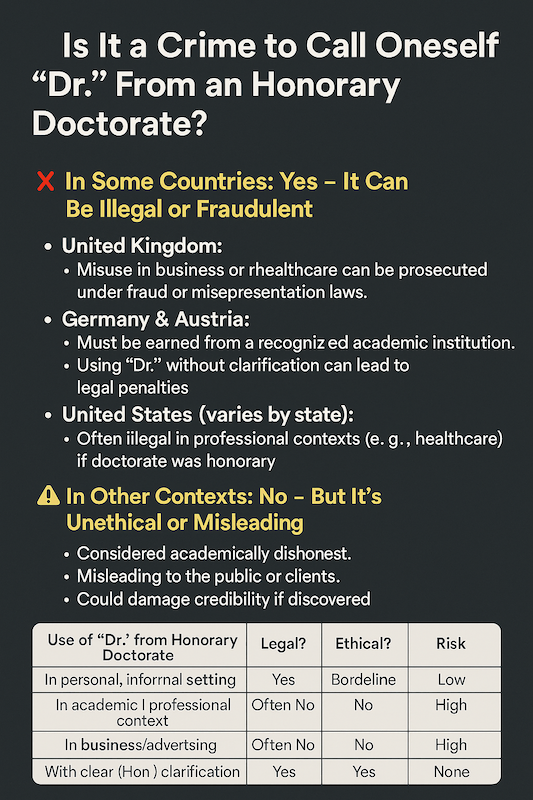
Honorary Doctorate vs Earned Ph.D.
Honorary vs Earned: A Clear Comparison
| Aspect | Honorary Doctorate | Earned Ph.D. (Doctor of Philosophy) |
|---|---|---|
| Basis | Recognition of achievement | Academic qualification |
| Work Required | None | 3–7 years of rigorous research |
| Dissertation/Defense | Not applicable | Mandatory |
| Legal Use of “Dr.” | Restricted/controversial | Fully legal and accepted |
| Ethical Use of “Dr.” | Should be labeled as (Hon.) | No restrictions |
| Purpose | Celebrate societal contribution | Advance academic knowledge |
| Academic Authority | None | Full (can publish, teach, supervise) |
| Public Role | Inspirational | Expert/Scholar |
| Media Visibility | High | Varies |
When in Doubt—Clarify
A simple solution exists: transparency.
If a recipient of an honorary doctorate wishes to use the title “Doctor” in any form, the ethical norm is to always include “(Hon.)” or clearly state the honorary nature of the title.
True prestige does not come from titles—but from what they represent. And clarity protects everyone involved.
Honor the Difference : Honorary Doctorate vs Earned Ph.D.
Both honorary doctorates and earned Ph.D.s serve important functions in society. One uplifts voices and contributions from outside academia. The other represents the pinnacle of academic discipline and original thought.
But they must not be confused.
To conflate honorary with earned is to dilute the value of both.
Let us celebrate both achievement and scholarship. Let us give each the dignity it deserves—without pretending they are the same.
For Event Media Coverage can contact us by email to us
Please subscribe our Youtube channel for more updates
https://www.youtube.com/@ALMediaChannel
MALAYSIA MOST CREATIVE INTERIOR PHOTOGRAPHER, ALAN LIM
https://www.alifebe.com/malaysia-interior-photographer-alan-lim/
ALAN LIM, Founder of AL Media Group
http://www.alan-lim.com